

faster to shortlist properties
The bot understands “a two-bedroom in the centre under 12 million”, searches the live database and answers on the website and in Telegram; the sales team handles the difficult customers.
A no-code platform for voice and text agents: from the first scenario to a working line.
The first agent is built in 72 hours
These are not eight different products but eight scenarios on one engine. A new agent appears through configuration, not development.
Answers routine contacts by voice and in chat, and hands the rest to an agent together with the context.
Finds the answer in your regulations, price lists and instructions and shows the clause it came from.
Parses the conversation and sorts it into the fields of the record: topic, agreements, next step.
Calls down a list: reminds people of an appointment, confirms an order, collects feedback.
Answers newcomers’ questions, runs onboarding, books meetings and collects surveys.
Runs the briefing, asks questions about the material and checks that the employee has taken it in.
Collects a summary of contacts, sets tasks from a meeting, reminds people of deadlines.
Checks data in three systems, assembles a set of documents, opens a request and calls a person in where a decision is needed.
Eight steps from the task to a working environment. Programming is only needed where you choose to write a function of your own.
What the agent has to do, and where its responsibility starts and ends.
Our own speech and language model or an open one — whichever fits the task and your network better.
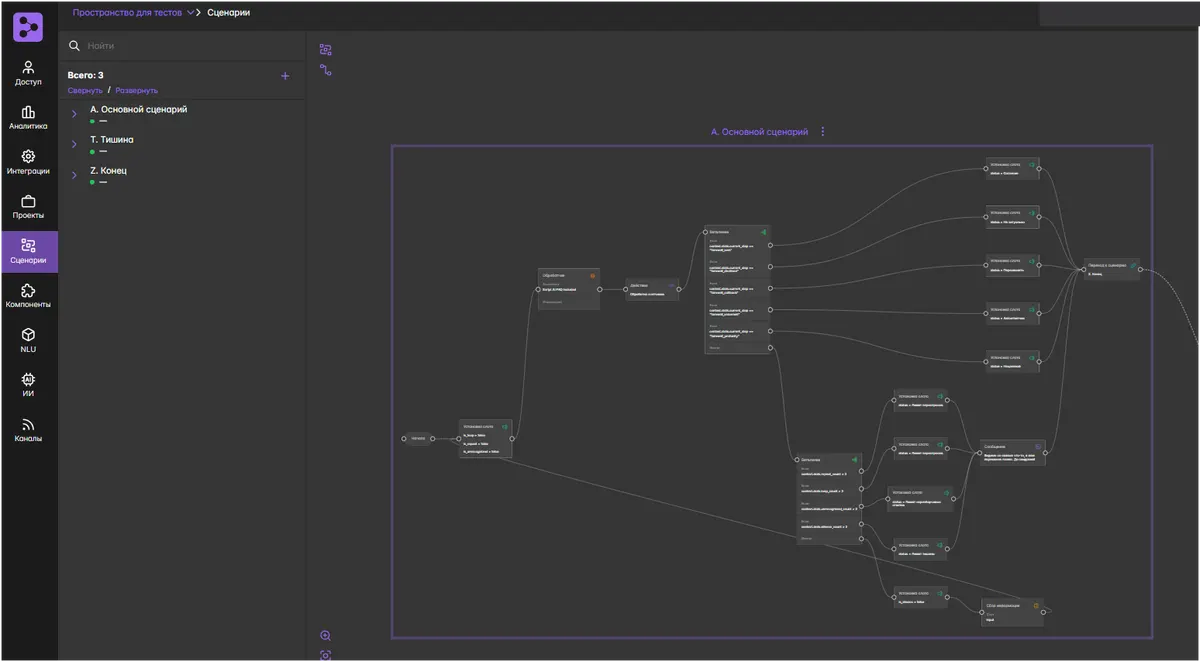
Lines, conditions, actions and the handover to a person — with the mouse, in one editor, without code.
Documents, knowledge bases, CRM and internal services: the agent answers from your data and can change something in it.
On-Premise on your own servers or in the cloud — whichever your security team requires.
We run real contacts through it and see where the agent is confident and where it calls a person in.
We open it on part of the flow, watch the quality of the answers and widen it step by step.
More channels, more scenarios, more load — without rewriting what already works.
What the platform does out of the box, without rework for every new scenario.
Scenarios, lines and conditions are configured with the mouse. For anything unusual there are JavaScript snippets.
One scenario works on the phone line, in a messenger and on the website.
Several agents in one process: one reads, another checks, a third files the result.
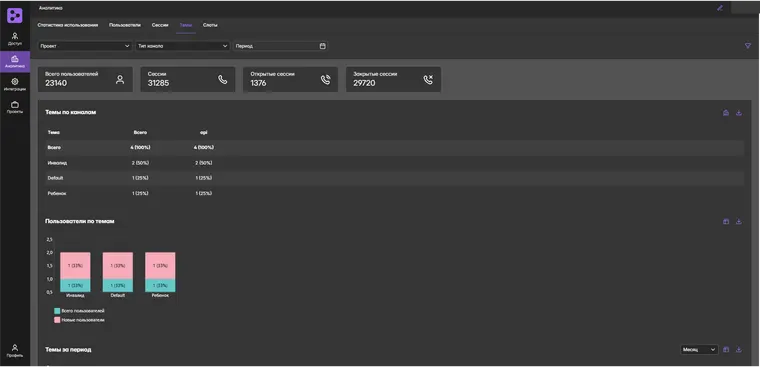
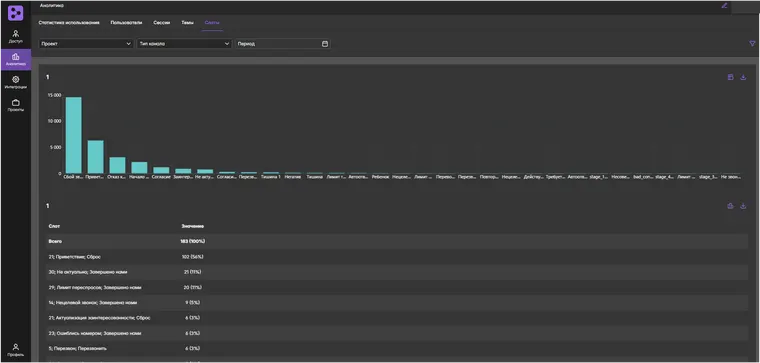
You see what people ask about, where the agent could not cope and which scenarios need rewriting.


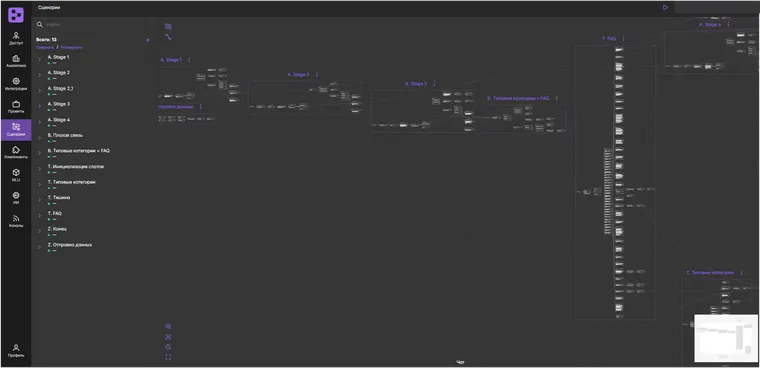
A scenario is built with the mouse, seen whole as a map, and the analytics show straight away what people ask about and where the agent could not cope.
One agent parses what comes in, a second checks it against the rules, a third files the result. A person steps in where a decision is needed.
For the people who will deploy and support it: what the platform is built from and what it runs on.
RAG on an Elasticsearch vector store with re-ranked answers: the agent answers from your documents and shows where it took the answer from.
Our own streaming recognition model and several synthesis options: the agent hears and speaks, not only types.
The customer’s intent is worked out before the language model is called. On a routine contact that is faster and cheaper.
The SOTA LLM family — from a small model to a large one — or an external model. The choice changes through configuration, not by rewriting integrations.
Models run with batching and caching. Ordinary server graphics cards are enough; the top of the range is not needed.
Where precision is needed the step is fixed; where flexibility is needed the model works. One does not rule out the other.
The agent is embedded into your application with a request. Streaming mode returns the answer as it is produced and keeps the session state.
External tools connect over a common protocol instead of a separate integration for every service.
The platform and the models are deployed inside your own network or in the cloud. The data does not leave it unless you want it to.
The set and the versions of the models are settled at the start of the project, against the load and the security requirements.
An agent works the same hours as an agent on the line, but it has no holidays, no sick days and no breaks.
The platform, the models and the documents are deployed inside your own network. Neither the request nor the answer goes outside.
The agent only answers from data the employee has access to. HR documents will not surface for an agent on the line.
You see who asked about what. That is both an audit trail and a hint about which regulations need rewriting.
Case study
697entries judged in 1 hour
A jury of people would have spent more than 7,000 hours on the same work
The organisers described what counts as a strong entry.
Every entry is assessed against all the criteria at once.
Not just a mark, but an explanation of why that mark.
People review the borderline cases, not all 697 entries one by one.
Case study
The agent parses a call or a chat and sorts it into the CRM fields: topic, product, agreements, next step. The person checks and confirms.
At a logistics company errors in the data fell by 40%: the agent does not forget fields and does not mix up numbers.
A new scenario stops being a development project and becomes a configuration task.
We start not with the platform but with the one process that carries the most routine.
The one with many repetitive contacts, where it is clear what a correct answer looks like.
Regulations, instructions, access to systems. Files as they are — there is no need to rewrite them.
The agent takes a share of the contacts, the rest go to people. We see where it is confident and where it gets things wrong.
We add channels and scenarios and build the next agent beside it, on the same data.
No. The scenario, the lines, the conditions and the handover to a person are configured in the editor with the mouse. A developer is needed where you choose to add an unusual function yourself, or to connect a system that has no ready API.
Ours or an open one — whichever fits the task and the security requirements better. In a closed network the models run on your own servers. We do not tie you to one supplier: the model is swapped without rewriting the integrations.
Word, PDF, Excel, presentations, plain text and pages from internal portals. Scans are recognised if the text on them is legible. Tables are parsed with their structure, not as a solid block of text.
It says so and passes the contact to a person together with the history of the conversation. Such cases are collected into a report that shows which data needs filling in and which scenario needs rewriting.
A pilot on one process takes a few days. What takes longest is not building the agent but agreeing on what counts as a correct answer.
Show us the process with the most routine in it. We will build an agent on your data and look together at what it answers.